On October 14, 2026, the blockchain studio Rock'n'Block published a long explainer on ERC-8004, the Ethereum standard for giving AI agents an identity and a reputation. The standard has been live on Ethereum since January, is still marked as a draft, and keeps coming up whenever people ask how a shop should know which AI agent it is dealing with. This post explains it for people who run online stores, not people who write smart contracts.
Facts are linked to the source we read. Anything marked “our analysis” or “prediction” is ours, and comes with what would prove it wrong.
What is ERC-8004?
ERC-8004 is a proposed Ethereum standard that lets AI agents be discovered and assessed by people and other agents they have never dealt with before. Its official name is Trustless Agents. “Trustless” does not mean untrustworthy. It means you do not need a prior relationship with the agent, because you can look up its record yourself.
- Who wrote it. Marco De Rossi, Davide Crapis, Jordan Ellis and Erik Reppel, according to the official proposal, which was created on August 13, 2025. Cointelegraph identifies De Rossi as head of AI at MetaMask and Crapis as AI lead at the Ethereum Foundation.
- Status. Still a Draft on the Ethereum proposals site, so its interfaces can change.
- Where it runs. The registries went live on Ethereum mainnet at the end of January 2026, per Cointelegraph. The reference contracts list the same registry address on about 25 networks, including Base, Arbitrum, Optimism and Polygon.
- Why it exists. The proposal says agent protocols such as MCP and A2A describe how agents talk, but not how to find an agent or decide whether to trust it. ERC-8004 is meant to fill that gap.
How does ERC-8004 work?
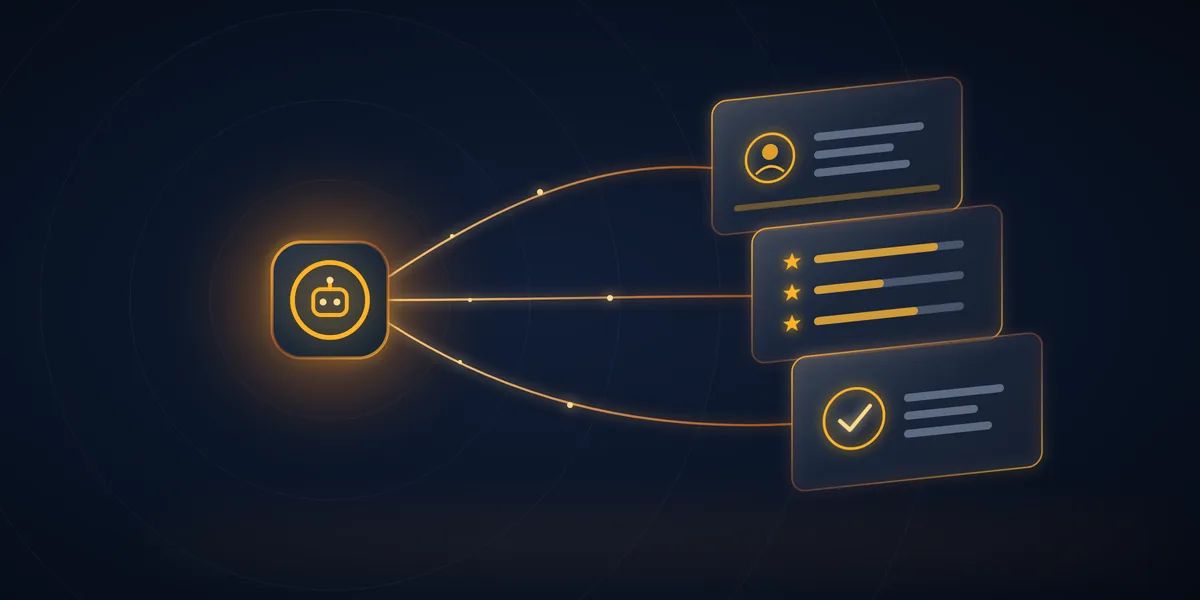
It defines three registries, each a smart contract anyone can read. The blockchain holds identifiers, scores and links. The agent itself, its model and its detailed results stay off-chain.
| Registry | What it records | A store-world comparison |
|---|---|---|
| Identity | An agent ID (an ERC-721 token the owner controls), and a link to a registration file with the agent's name, description, services such as an MCP endpoint or an A2A agent card, and a wallet for payments. | A business listing that says who you are and where to reach you. |
| Reputation | Feedback from clients: a score, tags, and optionally a link to details. Owners cannot rate their own agent. | Reviews, except the reader chooses whose reviews count. |
| Validation | Requests for an independent check of a specific piece of work, and the validator's answer on a 0 to 100 scale. | An inspection certificate for one job, not for the business. |
Two details matter more than they look. First, when someone asks for an agent's reputation summary, they have to name the reviewers they want counted. There is no single global score: each application decides whose opinion it trusts. Second, the validation part is unfinished. The contracts repository says it is “still under active update and discussion with the TEE community,” meaning the teams working on tamper-proof hardware for checking results.
How many agents use ERC-8004?
Hundreds of thousands are registered. How many do paid work is not known. When we checked 8004scan, a third-party explorer, on October 16, 2026, it showed 623,011 registered agents and 701,052 feedback entries across 29 networks.
Read those numbers with care. Registering costs little, one owner can register many agents, and feedback can come from wallets the owner controls. Rock'n'Block's explainer flags the same risk: one party posing as many independent clients. A registration count tells you how many ID cards exist, not how many agents are buying or selling anything.
What does ERC-8004 not do?
More than people assume. The proposal itself says: “Payments are orthogonal to this protocol and not covered here.” Rock'n'Block's explainer lists the rest:
- No payment, escrow, refunds or disputes. Those have to be designed separately.
- Registration is not verification. An agent can claim a capability it does not have. A matching hash shows a file was not altered, not that it is true.
- Reputation can be gamed, and scores without shared definitions cannot be averaged in any meaningful way.
- Records can go stale. Registration files hosted on ordinary web servers can go offline, and an agent can change owner, which changes what its old feedback means.
- No cross-network score. The same agent registered on two networks has two separate records.
How does ERC-8004 fit with MCP, A2A and x402?
Each covers a different layer. Having one does not mean an agent has the others.
| Protocol | Its job |
|---|---|
| MCP | Lets an agent use tools and data on a server, such as a store's catalog. |
| A2A | Lets agents talk to each other and hand off tasks. |
| ERC-8004 | Records who an agent is, what others said about it and whether its work was checked. |
| x402 | Lets a client pay for a request over HTTP, usually in stablecoins. See the x402 docs. |
| Web Bot Auth | Lets an agent sign each web request so a site can verify which agent sent it. Not part of ERC-8004; covered below. |
A typical flow in the ERC-8004 world: a client agent finds a service agent in the registry, pays it per request with x402, then leaves feedback. Rock'n'Block is careful to call this one possible scenario, not a sequence the standard requires.
Does ERC-8004 matter for online stores?
Not directly, yet. It was built for agents hiring other agents, mostly in crypto-native markets, not for a shopper's assistant buying a jacket. But it touches three questions every store will face.
1. How do you know which agent is at your door?
This is the problem behind Amazon's block on Meta's Muse, which we covered in how Meta's Muse agent will impact ecommerce: Amazon said the agent did not identify itself.
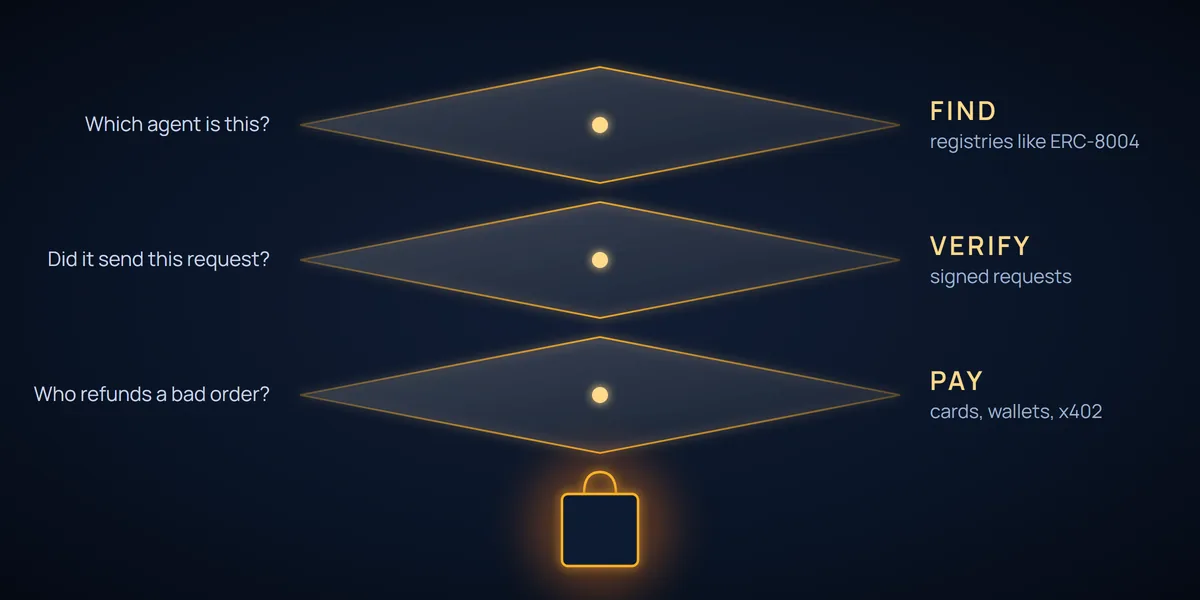
Our analysis: ERC-8004 tells you who an agent is in a directory. It does not tell you that the request hitting your product page right now came from that agent. For web traffic, the approach with commercial backing is signed requests. Web Bot Auth lets an agent sign every HTTP request with a public key, and Cloudflare says both Visa's Trusted Agent Protocol and Mastercard's Agent Pay “leverage Web Bot Auth as the agent authentication layer.”
Prediction: stores will verify shopping agents through their CDN, bot-protection vendor and card networks, not by looking agents up on a blockchain.
- What would prove us wrong: a major bot-protection vendor or ecommerce platform checking ERC-8004 records before letting an agent through checkout.
2. Could agents find your store through a registry?
Possibly, if you run something an agent can call. A store that exposes its catalog through an MCP server or an A2A agent card could register it, and the registration file becomes one more public description pointing at it, much like a product feed.
Our analysis: the shopping agents your customers use today build their shortlist, what we call the candidate set, from search results, feeds, partner catalogs and the open web. We have found no announcement from OpenAI, Google or Meta that their shopping agents read ERC-8004. A registry entry is worth it now only if you already sell to crypto-native buyers or run an agent endpoint.
- What would prove us wrong: a consumer shopping agent citing an ERC-8004 registration as the reason it found or chose a store.
3. What happens to reviews when the reader picks the reviewers?
ERC-8004's reputation design has no star average. Each reader names the reviewers it trusts and ignores the rest.
Our analysis: that is a fair description of how AI agents already treat reviews of products. They lean on sources they consider credible, such as named publications, verified-buyer reviews and well-moderated forums, and discount the rest. A thousand five-star reviews on your own site count for less than they used to. Reviews in the places agents trust count for more. That is the job of the Cite part of our service.
A note on payments
Where ERC-8004 agents pay each other, it is usually in stablecoins through x402. Card payments come with chargebacks and a dispute process. Stablecoin payments do not, and ERC-8004 does not add one. If agent payments ever reach your checkout on crypto rails, refunds and disputes become something you design yourself.
What should a store do about ERC-8004 now?
Very little on-chain. These four steps help whether or not ERC-8004 catches on.
- Don't register anything yet unless you sell to crypto-native buyers or already run an MCP server or agent endpoint. Be wary of anyone selling “on-chain reputation” for a store.
- Ask your CDN or bot-protection vendor, in writing, whether it verifies signed agent requests (Web Bot Auth) and how it treats verified shopping agents at checkout.
- Get the basics right first. Product schema, a complete feed, and a delivered price, delivery date and returns policy on the page as text. That is what shopping agents read today. Run the free check on your best seller to see where you stand.
- If you publish anything for agents, such as an MCP server, an agent card or llms.txt, treat its description like a product page: specific, accurate and up to date.
What do we still not know?
How many registered agents do real, paid work. Whether the validation registry will ship in a form anyone uses. Whether any large consumer agent will read the registries. And whether ERC-8004 and signed web requests will ever meet: an agent's registration file could, in principle, publish the key it signs requests with, but we have seen no standard that does so.
The pattern is the same as everywhere else in agentic commerce. Agents prefer what they can read and verify. Standards like ERC-8004 make agents more legible to each other. Your job is to make your store legible to them.
Key takeaways
- ERC-8004 (“Trustless Agents”) is a draft Ethereum standard with three registries: identity, reputation and validation for AI agents.
- It has been live on Ethereum mainnet since late January 2026 and is deployed on about 25 networks. The validation part is still being revised.
- It does not handle payments, refunds or disputes, and registration does not prove an agent can do what it claims.
- We have found no announcement that ChatGPT, Gemini or Meta's Muse use it for shopping.
- For stores, verifying agent traffic is more likely to come through signed web requests (Web Bot Auth) via CDNs and card networks.
Questions and answers
What is ERC-8004?
ERC-8004, called Trustless Agents, is a draft Ethereum standard that gives AI agents an on-chain identity, a public record of feedback and a way to request independent validation of their work. It was created on August 13, 2025 and helps people and agents find and assess agents they have not dealt with before.
Is ERC-8004 live?
Yes, although it is still a draft. Its identity and reputation registries went live on Ethereum mainnet in late January 2026 and are deployed on about 25 networks, including Base, Arbitrum, Optimism and Polygon. The validation registry is still being revised, and the interfaces can change.
Does ERC-8004 handle payments?
No. The proposal says payments are orthogonal to the protocol and not covered. Payments between agents usually go through a separate protocol such as x402, and ERC-8004 adds no escrow, refunds or dispute process.
Do online stores need to register as ERC-8004 agents?
Not yet, for most stores. We have found no announcement that the major consumer shopping agents, such as ChatGPT, Gemini or Meta's Muse, read ERC-8004 registries. A registration is only worth considering if a store sells to crypto-native buyers or already runs an MCP server or agent endpoint.
How is ERC-8004 different from Web Bot Auth?
ERC-8004 is a directory that records who an agent is and what others say about it. Web Bot Auth lets an agent sign each web request so a website can verify which agent sent it. Visa's Trusted Agent Protocol and Mastercard's Agent Pay build on Web Bot Auth, not on ERC-8004.
Sources
All read on October 16, 2026.
- Ethereum Improvement Proposals, ERC-8004: Trustless Agents, created August 13, 2025, status Draft.
- Rock'n'Block, ERC-8004: what the standard is and how it builds trust infrastructure for AI agents, October 14, 2026.
- ERC-8004, erc-8004-contracts repository on GitHub: deployments and Validation Registry status.
- Cointelegraph, Ethereum AI agent standard ERC-8004 launches this week, January 28, 2026.
- 8004scan, ERC-8004 explorer, figures as shown on October 16, 2026.
- Cloudflare, Securing agentic commerce: helping AI agents transact with Visa and Mastercard, October 24, 2025.
- x402, documentation.
Written by Harry Harrison, founder of Recommended by Agents, under our editorial standards. Found an error? Tell us. Published . This is not investment advice. Ethereum, MetaMask, Cloudflare, Visa, Mastercard, Rock'n'Block and other names are trademarks of their owners, and we have no affiliation with them.